Work / Project details
Allied Irish Bank
Company
Product Designer
My Role
Mobile
Platform
4 months
Timeline
The UK Government mandated the ‘Confirmation of Payee’ feature for all banks to enhance security and reduce fraud in online payments. The deadline for integration was November 2023. Our challenge was to incorporate this feature into the AIB UK mobile app while ensuring compliance and maintaining a seamless user experience.

Constraints and discovery
The feature had to work across several payment journeys and support up to 10 possible verification outcomes. The design was shaped by three key constraints:
Government-mandated wording and security requirements
Fraud-warning guidance for higher-risk situations
A familiar, low-friction flow for customers
Breaking down the requirements

Analysing the current journey

Competitor analysis

Designing the payment journey
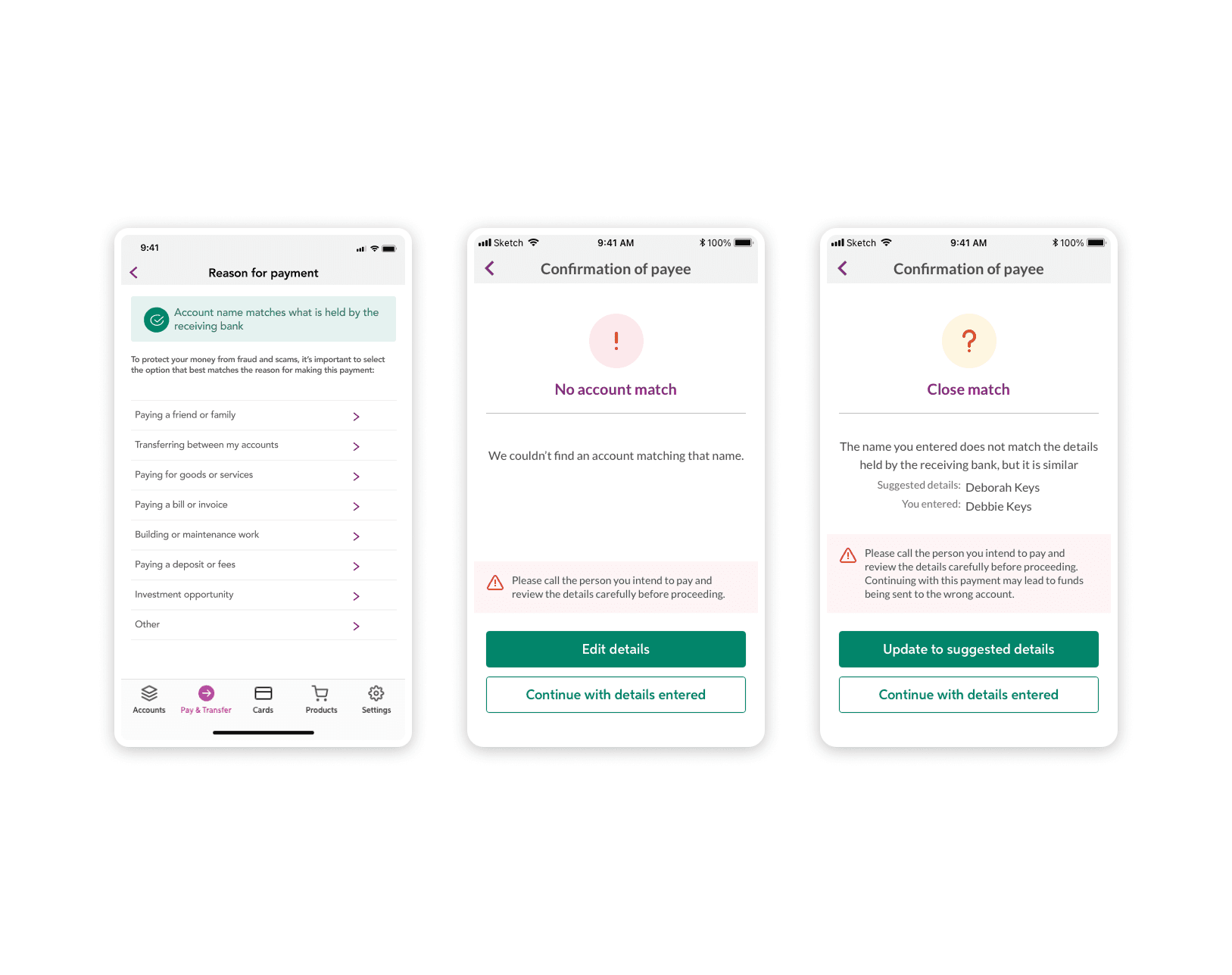
I mapped the payment journey and prioritised the three outcomes customers were most likely to encounter:
Full match: Confirms the recipient details match.
Close or partial match: Flags a near match and suggests the correct details.
No match: Warns that the entered name does not match the account details.
I explored multiple concepts, reviewed them with design and technical stakeholders, and progressed the strongest approach into higher-fidelity prototypes

Task flow exploration

Early concept creation
Progressing to higher fidelity
Design critique and iteration
I presented the developing designs in critique sessions with the design team. These sessions helped test assumptions, surface risks early, and gather feedback from different perspectives before progressing the work.
One key discussion was around balancing safety and friction. For higher-risk outcomes, adding a small amount of friction was appropriate when it encouraged customers to pause and review their payment details.

I used this feedback to refine the hierarchy, content, and escalation of the verification outcomes before user testing.
Usability testing
I conducted moderated usability testing with five AIB customers. Each session lasted 45–60 minutes and explored how participants understood the verification outcomes, fraud guidance, and overall payment journey.
Preparing the test
Preparing for the testing phase by defining test scenarios, recruiting participants, and setting up testing environments.
2. Carrying out the Tests
The usability tests were carried out on 5 existing AIB employees. Each test ran for 45-60 minutes. While testing the users, another member of design team took ongoing notes to highlight any behaviours and timestamp important moments during the test.
Analysing the data
Analysing the data collected during testing to extract meaningful insights about user behavior, preferences, and pain points.
Developing insights
The final step of the Usability testing was to develop actionable insights based off the data we got from testing. These insights were crucial for progressing the designs and creating a more user friendly experience.
Customers double check details before continuing with a "negative outcome".
Customer found outcomes to be cause of their own input of details.
Customers did not engage with the information banner on the input screen.
Customers didn't see link between 'Reason of Payment' dropdown and fraud warning screen.
Customers found overall journey was long with too much friction but navigation was straight forward.
Customers found the 'Reason for Payment' field to be unnecessary.
Final solution
After completed testing we applied the insights to the design to and finalised the design:
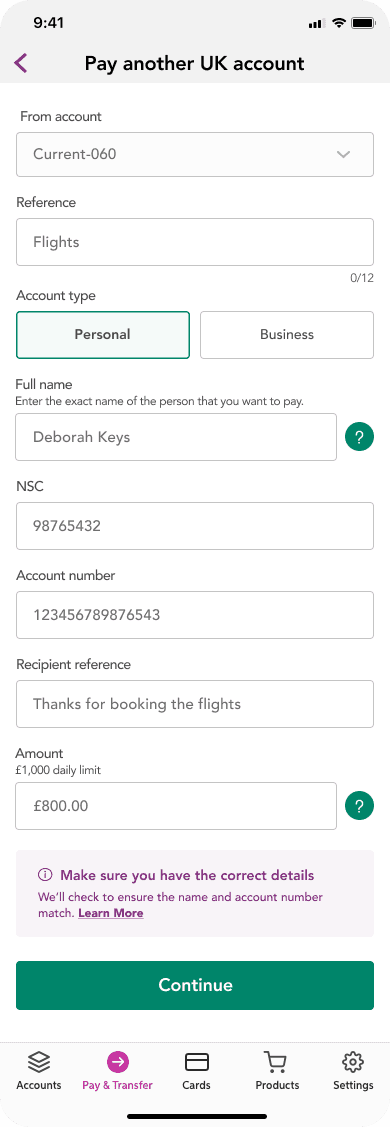
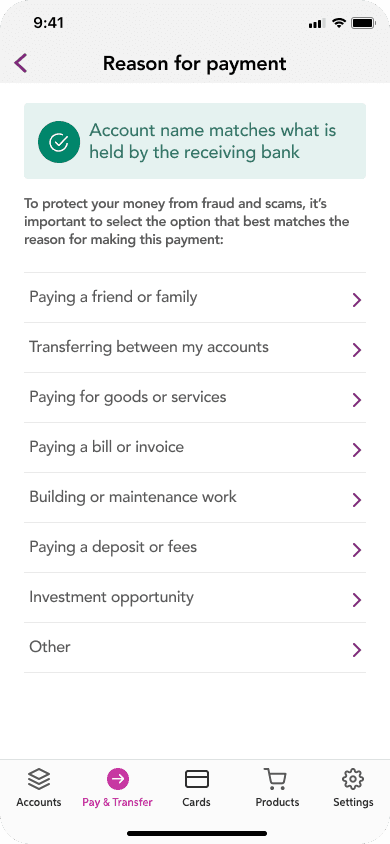
Full account match
A clear, unobtrusive confirmation reassures the customer that their recipient details match.



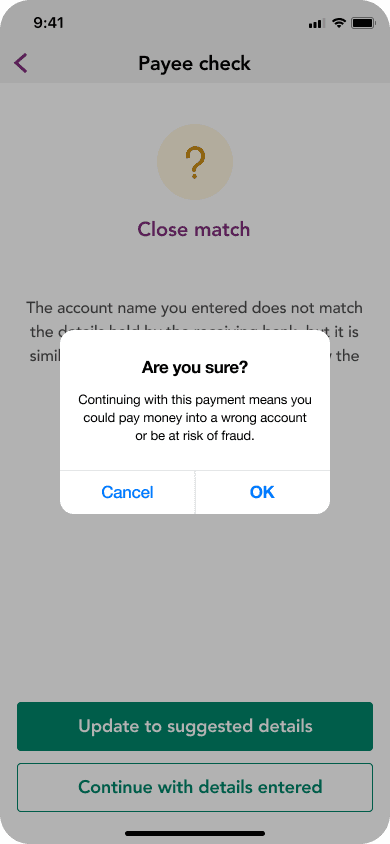
Close or partial match
The experience explains the mismatch and offers corrected recipient details where available.


No account match
A stronger warning helps the customer pause, review their information, and avoid a potentially unsafe payment.


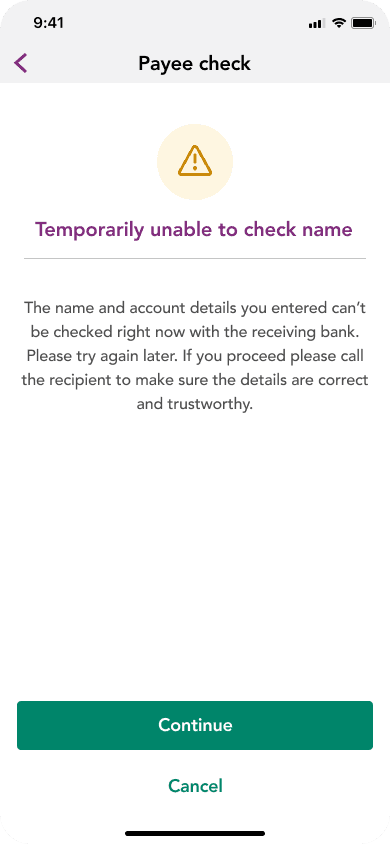
Other possible outcomes


Outcome and learnings
The final design delivered a compliant Confirmation of Payee journey that helped customers understand recipient-verification outcomes before completing a payment.
This project reinforced the value of involving compliance, design, engineering, and customers early. Utilising design critiques and usability testing helped turn complex requirements into a clearer experience, with less iterations & back and forth conversations with stakeholders.
